
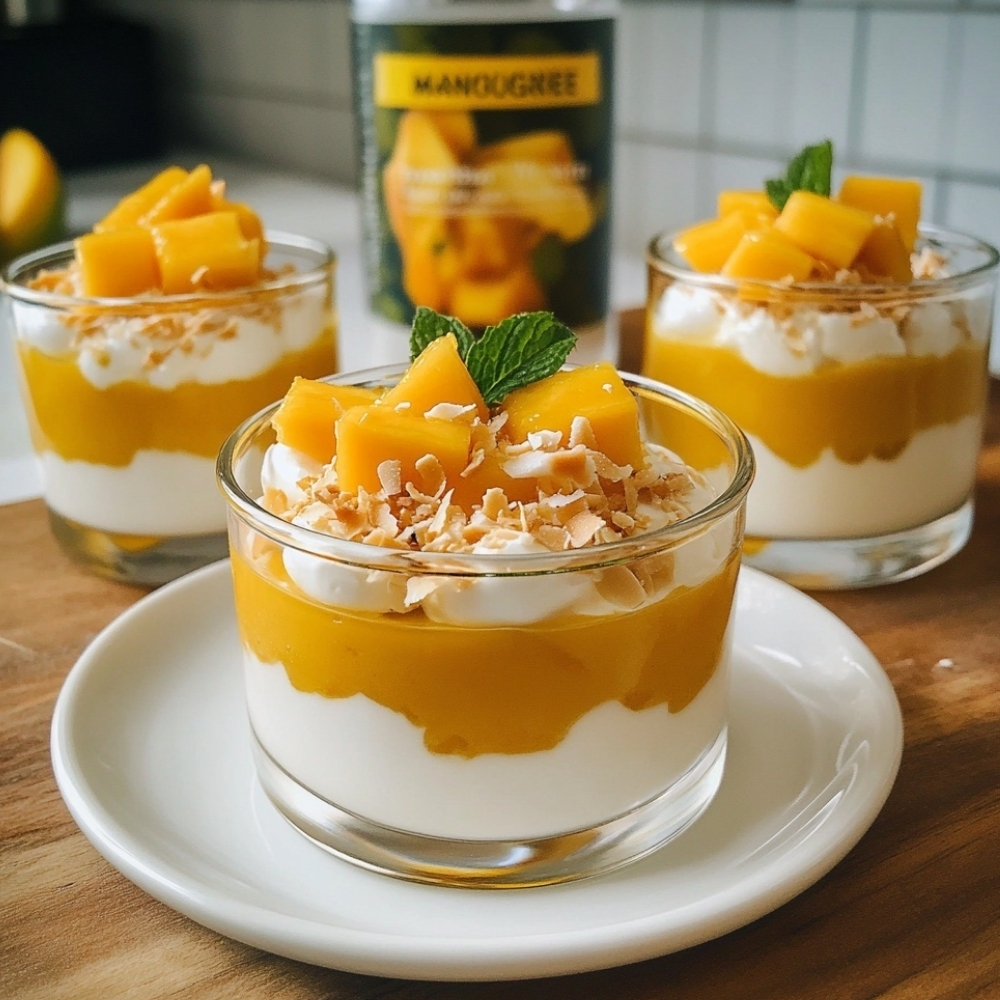
These Homemade Mango & Coconut Mousse Verrines are like a little tropical vacation in a glass. You get a buttery biscuit crumble at the bottom, a silky mango layer bursting with fruitiness, and a light, creamy coconut mousse on top—finished with fresh mango and toasted coconut.
They’re elegant but easy, completely no-bake, and perfect for make-ahead entertaining. Each spoonful is a mix of tangy-sweet mango, airy coconut cream, and a bit of crunch from the base—light enough after a big meal, but still totally satisfying.
Why You’ll Love These Mango & Coconut Mousse Verrines
- No-bake dessert – The fridge does all the work; no oven needed.
- Light and airy – Creamy mousse texture that doesn’t feel heavy.
- Tropical flavor – Mango + coconut = instant sunny vibes.
- Perfect for guests – Individual portions that look fancy in small glasses.
- Make-ahead friendly – Chill well and hold beautifully in the fridge.
Ingredients
For the Biscuit Crumble Base
- 120 g (about 1 cup) crushed digestive biscuits or graham crackers
- 40 g (3 tbsp) unsalted butter, melted
- 1–2 tbsp shredded coconut (desiccated, optional for extra flavor)
For the Mango Layer
- 300 g (about 1¼ cups) mango purée
- (from fresh ripe mangoes or good-quality frozen/thawed mango)
- 2–3 tbsp sugar or honey (adjust to sweetness of mango)
- 1 tbsp lime juice (optional, for brightness)
- 5 g (about 1½–2 tsp) powdered gelatin
- 2 tbsp cold water (for blooming gelatin)
For the Coconut Mousse
- 240 ml (1 cup) heavy cream, well chilled
- 200 ml (about 3/4–1 cup) full-fat coconut milk or coconut cream, chilled
- 60–70 g (1/3 cup) powdered sugar (or fine granulated)
- 1 tsp vanilla extract
- 5 g (about 1½–2 tsp) powdered gelatin
- 2 tbsp cold water (for blooming gelatin)
For Garnish (Optional but Lovely)
- Fresh mango cubes
- Toasted shredded coconut
- Lime zest or mint leaves
Instructions
1) Prep the glasses and base
Set out 6–8 small glasses, jars, or verrine cups.
In a bowl, mix crushed biscuits, melted butter, and shredded coconut (if using) until the texture resembles wet sand.
Spoon a couple of tablespoons of the mixture into the bottom of each glass. Press down gently with the back of a spoon to form a light base.
Chill the glasses while you prepare the mango layer.
Tip: Don’t press the base too hard; you want it to be slightly crumbly under the mousse.
2) Make the mango layer
Sprinkle 5 g gelatin over 2 tbsp cold water in a small bowl and let stand for 5 minutes to bloom.
In another bowl, stir together mango purée, sugar or honey, and lime juice (if using). Taste and adjust sweetness.
Gently heat the bloomed gelatin (microwave a few seconds or over a small pan of hot water) until fully dissolved—do not boil.
Stir the melted gelatin into the mango mixture until fully combined.
3) Layer the mango into the verrines
Remove the glasses from the fridge.
Carefully spoon or pour a layer of mango mixture over the biscuit base in each glass (fill about 1/3–1/2 of the glass, depending on how many layers you want).
Refrigerate for 20–30 minutes, or until the mango layer is just starting to set and no longer liquid on top.
Tip: Slightly set mango makes layering the coconut mousse cleaner and prevents layers from blending.
4) Make the coconut mousse
Again, bloom 5 g gelatin over 2 tbsp cold water and let sit for 5 minutes.
In a chilled bowl, whip the heavy cream with powdered sugar and vanilla until soft peaks form.
In a separate bowl, gently whisk the chilled coconut milk/cream to smooth it out.
Melt the bloomed gelatin (as before) until dissolved and let cool just a moment (it should be warm, not hot).
Stir the melted gelatin into the coconut milk/cream mixture.
Gently fold the coconut mixture into the whipped cream in two or three additions, keeping as much air as possible. You should have a light, airy coconut mousse.
5) Add the coconut mousse layer
Once the mango layer is lightly set, spoon or pipe the coconut mousse on top of the mango in each glass.
Smooth the tops or create a soft swirl with the back of a spoon.
Chill for at least 2 hours (or up to overnight) until fully set and nicely chilled.
6) Garnish and serve
Just before serving, top each verrine with fresh mango cubes, toasted shredded coconut, and a little lime zest or a mint leaf if you like.
Serve well chilled with small spoons so you get biscuit, mango, and coconut in every scoop.
Serving Suggestions
- Serve as a light dessert after a rich meal, especially with seafood or grilled dishes.
- Perfect for dinner parties, Ramadan/holiday gatherings, or summer evenings.
- Present on a tray with extra mango, lime wedges, and toasted coconut in small bowls.
- Dress them up with mini dessert spoons and a dusting of coconut around the rim.
Cook’s Tips
- Use ripe mangoes: The better the mango, the better the dessert—choose sweet, fragrant fruit.
- Chill everything well: Cold cream whips better and gives a lighter mousse.
- Don’t boil gelatin: Overheating can destroy its setting power; warm just until melted.
- Go easy on the sugar: Mango and coconut are naturally sweet—add sugar gradually and taste as you go.
- Neat layers: For very clean lines, pipe the coconut mousse using a piping bag instead of spooning.
Variations & Add-Ins
- Agar-agar option: Swap gelatin for agar (adjust quantity according to package directions) for a vegetarian version.
- Crunch upgrade: Add a few chopped toasted nuts (macadamia, pistachio, or almonds) on top.
- Extra tangy: Add a thin layer of slightly sweetened Greek yogurt between mango and coconut.
- Passionfruit twist: Swirl a spoonful of passionfruit pulp into the mango layer or drizzle on top.
- Chocolate base: Use chocolate biscuits instead of plain for a more dessert-like, indulgent base.
Storage & FAQ
- Storage: Keep verrines covered in the fridge for up to 2–3 days. Garnish just before serving.
- Make-ahead: You can make the base, mango, and coconut mousse layers the day before and decorate on the day of serving.
- Freezing: Not recommended; freezing can change the texture of the mousse and mango layer.
- No gelatin? The verrines will be softer and more like a parfait. You can use less or skip it, but layers will not be as firm.
- Can I use canned mango? Yes, use good-quality canned mango pulp; adjust sugar since it may already be sweetened.
Homemade Mango & Coconut Mousse Verrines give you layers of biscuit crunch, silky mango, and airy coconut cream in an easy, no-bake dessert that looks elegant in the glass and tastes like a tropical escape—perfect for make-ahead entertaining or a special family treat.
Homemade Mango & Coconut Mousse Verrines – Light, Creamy & Tropical

No-bake layered mango and coconut mousse verrines with a buttery biscuit base, a lightly set mango layer, and airy coconut mousse on top. Finished with fresh mango and toasted coconut for a light, tropical dessert that’s perfect for make-ahead entertaining.
Ingredients
- For the Biscuit Base:
- 120 g (about 1 cup) crushed digestive biscuits or graham crackers
- 40 g (3 tbsp) unsalted butter, melted
- 1–2 tbsp shredded coconut (optional)
- For the Mango Layer:
- 300 g (about 1¼ cups) mango purée
- 2–3 tbsp sugar or honey (to taste)
- 1 tbsp lime juice (optional)
- 5 g (1½–2 tsp) powdered gelatin
- 2 tbsp cold water (for blooming)
- For the Coconut Mousse:
- 240 ml (1 cup) heavy cream, chilled
- 200 ml full-fat coconut milk or coconut cream, chilled
- 60–70 g (1/3 cup) powdered sugar
- 1 tsp vanilla extract
- 5 g (1½–2 tsp) powdered gelatin
- 2 tbsp cold water (for blooming)
- For Garnish (Optional):
- Fresh mango cubes
- Toasted shredded coconut
- Lime zest or small mint leaves
Instructions
- 1. Prepare the glasses and base
- 2. Arrange 6–8 small glasses or verrine cups.
- 3. In a bowl, mix crushed biscuits, melted butter, and shredded coconut (if using) until combined.
- 4. Divide mixture among the glasses, pressing lightly into the bottom. Chill while you prepare the mango layer.
- 5. Make the mango layer
- 6. Sprinkle 5 g gelatin over 2 tbsp cold water and let bloom for 5 minutes.
- 7. In a bowl, stir together mango purée, sugar or honey, and lime juice. Taste and adjust sweetness.
- 8. Gently melt the bloomed gelatin until dissolved (microwave a few seconds or use a hot water bath).
- 9. Stir the melted gelatin into the mango mixture until fully combined.
- 10. Layer the mango
- 11. Pour or spoon the mango mixture over the biscuit base in each glass (about 1/3–1/2 of the glass).
- 12. Refrigerate for 20–30 minutes, or until just beginning to set on top.
- 13. Make the coconut mousse
- 14. Bloom the remaining 5 g gelatin over 2 tbsp cold water for 5 minutes.
- 15. In a chilled bowl, whip the heavy cream with powdered sugar and vanilla until soft peaks form.
- 16. In another bowl, whisk the chilled coconut milk/cream until smooth.
- 17. Melt the bloomed gelatin until dissolved and slightly cooled, then stir it into the coconut milk/cream.
- 18. Gently fold the coconut mixture into the whipped cream in batches until smooth and airy.
- 19. Add the coconut layer
- 20. Once the mango layer is lightly set, spoon or pipe the coconut mousse on top of the mango in each glass.
- 21. Smooth or swirl the tops. Refrigerate for at least 2 hours, or until fully set and chilled.
- 22. Garnish and serve
- 23. Just before serving, top each verrine with fresh mango cubes, toasted coconut, and lime zest or a mint leaf.
- 24. Serve well chilled.
Notes
Adjust sugar to the sweetness of your mango and your taste preference.
For very clean, professional-looking layers, use a piping bag for the coconut mousse.
If using very thick coconut cream, loosen it slightly with a tablespoon or two of coconut milk before adding gelatin.
Verrines can be made a day ahead; add garnish at the last minute for the freshest look and texture.
Nutrition
Calories: ~260–300
Protein: ~3–4 g
Total Fat: ~17–20 g
Carbohydrates: ~26–30 g
Fiber: ~1–2 g